
Deciding between a targeted garage door repair and a full system overhaul is a high-stakes financial move for any homeowner. A standard garage door repair can resolve immediate safety risks, but ignoring systemic wear often leads to compounding expenses that exceed the price of a new unit. You must evaluate whether you are simply patching a symptom or investing in a long-term structural asset. Understanding the balance between upfront cost and long-term reliability is the only way to protect your home’s value.
Most homeowners underestimate the average life of a garage door, which typically spans 15 to 30 years, depending on maintenance cycles. If you find yourself frequently paying for garage door repair, you are likely throwing money at an obsolete system that lacks modern safety standards. High-performance insulated steel doors now offer superior durability and energy returns that old, damaged panels simply cannot match. Investing in a modern system eliminates the recurring headache of patching up a failing, outdated mechanical structure.
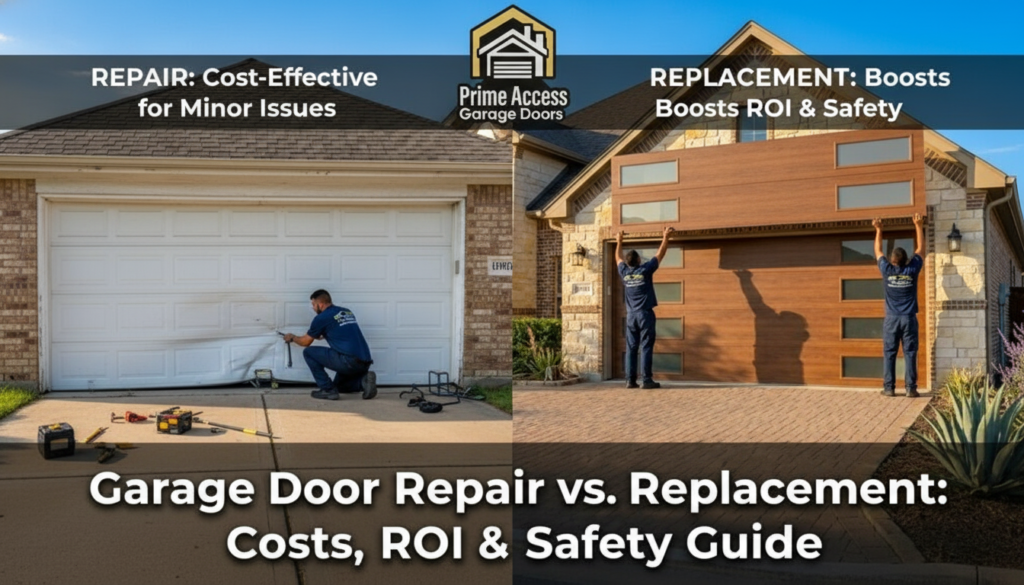
Understanding Garage Door Repair and Replacement
Choosing the wrong path—either over-repairing a dying door or replacing a perfectly salvageable one—wastes significant capital. A strategic assessment begins with the garage door repair cost vs replacement analysis, where you weigh the immediate invoice against the long-term operational efficiency of the home. If the structural integrity of the tracks is intact and the motor functions reliably, a repair is a logical fix. However, if the “bones” of the system are failing, continuing to repair individual components is a losing strategy that ignores the inevitable total failure. You must look at the signs that you need a new garage door before authorizing another minor fix that won’t last.
What Garage Door Repair Really Covers
Professional maintenance usually focuses on the mechanical tension and alignment required for daily cycles. Technicians prioritize torsion spring tension adjustments and hardware tightening to ensure the door remains balanced and safe for the opener to lift. When the damage is localized to a specific area, such as a dent from a vehicle or weather rot on a single section, a sectional panel replacement is the most cost-effective way to restore aesthetics. These repairs target specific failure points to extend the system’s life without requiring a complete teardown of the existing structure.
Sectional Panel Replacement
When a single board is compromised, you can calculate the garage door panel replacement cost to see if it beats the price of a full set. This targeted fix is ideal for cosmetic damage that hasn’t warped the underlying track system or strained the motor. It preserves the existing hardware while making the exterior look brand new. Professional installation ensures the new panel matches the weight and balance of the remaining sections.
Torsion Spring Tension
Maintaining proper torsion spring tension is the most critical factor in extending the life of your entire assembly. If these springs lose their force, the garage door opener compatibility becomes irrelevant because the motor will burn out trying to lift the dead weight. Professional calibration here prevents catastrophic cable snaps and ensures the door remains light enough for manual operation. Never attempt to adjust these high-pressure components without the proper technical tools and safety training.
When Garage Door Repair Usually Makes Sense
Repair is the definitive choice when the issue is isolated to wear-and-tear parts like weatherstripping and seals or minor sensor misalignments. These are low-cost, high-impact fixes that prevent moisture infiltration and protect the interior of your garage without requiring a massive investment. If your door is less than ten years old and the panels are structurally sound, replacing these peripherals will significantly boost performance. You should stick to repairs when the core structure is healthy and the goal is simply to maintain the current energy-efficient garage door upgrade you previously installed. Choosing a professional garage door repair for minor mechanical hiccups ensures you maximize the average life of a garage door before needing a full overhaul. Consistent maintenance on small components prevents the system from reaching a point of total structural failure prematurely.
What Garage Door Replacement Actually Means
A full garage door replacement is a comprehensive structural upgrade that involves removing every component of your existing system, from the tracks to the motor. Unlike a minor garage door repair, this process ensures that all parts are engineered to work in perfect synchronization, eliminating the risk of old hardware failing under the weight of new panels. This is a strategic move to install insulated steel doors that enhance the thermal envelope of your home while providing superior dent resistance. When you opt for a total replacement, you are essentially resetting the clock on the average life of a garage door. It is a long-term capital investment that prioritizes safety, curb appeal, and modern technology over temporary mechanical patches.
The Garage Door Replacement Basics
The foundation of a successful replacement lies in verifying garage door opener compatibility and ensuring the framing can support modern, heavy-duty materials. A standard installation includes new tracks, heavy-duty rollers, and high-cycle springs designed to handle thousands of operations without losing torsion spring tension. Professionals will also focus on the perimeter, installing high-grade weatherstripping and seals to prevent air leakage and pest intrusion. This process is not just about the door itself; it is about calibrating the entire opening system to meet current safety standards. By replacing the entire unit, you eliminate the “frankenstein” effect of mixing old, worn parts with new components, which often leads to premature failure.
How to Know When to Choose Garage Door Repair vs. Replacement
The decision typically hinges on the severity of structural damage and the age of the existing system compared to modern efficiency standards. If the door has sustained major frame warping or if you see multiple signs you need a new garage door, a repair is likely a waste of resources. However, if the issue is purely mechanical—such as a snapped cable or a misaligned sensor—a targeted garage door repair is the most logical and cost-effective path. You must calculate whether the cost of fixing multiple parts exceeds 50% of the price of a new energy-efficient garage door upgrade. When safety is compromised or the door is over 20 years old, the “repair” option becomes a liability rather than a solution.
Assessing Panel Integrity
If your door has suffered localized impact but the tracks are straight, a sectional panel replacement is often the best middle-ground solution. This allows you to restore the door’s appearance and balance without the high cost of a full system teardown. However, if multiple panels are sagging or rusted through, the garage door panel replacement cost may quickly approach the price of a completely new door.
Evaluating Mechanical Wear
Check the condition of your springs and rollers to see if they are nearing the end of their rated cycles. A simple adjustment of torsion spring tension can often solve balance issues, but brittle or rusted springs are a ticking time bomb. If the hardware is corroded beyond basic cleaning, replacing the entire system is the only way to ensure the safety of your vehicles and family.
Energy Efficiency Standards
Older doors lack the R-value and thermal breaks found in modern insulated steel doors, leading to significant heat loss in the winter. If your garage is attached to the house and feels drafty despite new weatherstripping and seals, the door itself is likely the culprit. Upgrading to a modern unit is an investment in your home’s energy performance that a simple repair cannot provide.
Factors Affecting Garage Door Repair or Replacement
Several variables dictate the financial and functional feasibility of keeping your current door versus starting fresh with a new installation. The availability of matching parts is a major factor; if your door model is discontinued, a sectional panel replacement becomes impossible or prohibitively expensive. You must also consider the frequency of use, as a high-traffic door will wear out its mechanical components much faster than one used occasionally. Local climate also plays a role, as extreme heat or coastal salt air can accelerate the degradation of even the best weatherstripping and seals. Ultimately, your decision should be guided by a professional inspection that identifies hidden fatigue in the tracks and support brackets.
Material Durability
The material of your door determines how well it stands up to the elements and mechanical stress over time. While wood looks premium, it requires high maintenance to prevent rot, whereas insulated steel doors offer a “set it and forget it” level of durability. Choosing a material that matches your local climate reduces the frequency of future garage door repair visits significantly. Investing in high-grade materials ensures the door remains structurally sound against high winds and temperature fluctuations.
Safety and Security Features
Modern doors come equipped with advanced rolling-code technology and force-sensing motors that older systems simply do not have. If your current system lacks manual release safety handles or modern photo-eye sensors, a replacement is a critical safety upgrade. Protecting your home from intruders and preventing accidental closures is worth more than the savings of a cheap repair. These integrated security features provide peace of mind that a patched-up, outdated system cannot replicate.
Professional Labor Costs
The complexity of the job directly impacts the garage door repair cost vs replacement ratio in your local market. Some repairs require two technicians and several hours of high-risk labor, making the price gap between fixing and replacing surprisingly narrow. Always get a detailed quote that includes the removal and disposal of the old door to see the true price difference. High labor costs on an old system are often a poor investment compared to the streamlined installation of a new unit.
Comparing Garage Door Cost: Repair vs Replacement
When comparing the garage door repair cost vs replacement, you are looking at a trade-off between immediate cash flow and future reliability. A typical repair might cost a few hundred dollars, but it does nothing to improve the home’s insulation or curb appeal. In contrast, a full energy-efficient garage door upgrade requires a larger upfront investment but pays for itself through lower energy bills and increased property value. You must stop looking at the invoice as a one-time expense and start viewing it as a cost-per-year calculation based on the average life of a garage door.
| Feature / Factor | Garage Door Repair | Garage Door Replacement | Strategic ROI Insight |
| Upfront Cost | $150 – $600 | $1,200 – $4,500+ | Repair is a tactical patch; Replacement is a capital asset. |
| Service Life | 1 – 5 Years (Component) | 15 – 30 Years (System) | Replacement resets the average life of a garage door. |
| Energy Efficiency | Minimal improvement | High (Insulated Steel Doors) | Upgrades slash utility leaks via superior R-values. |
| Safety Status | Patching old tech | Newest Safety Standards | Replacement removes liability of outdated spring systems. |
| Home Value | Neutral / Maintenance | 90%+ ROI on Resale | New doors are a top-ranked home improvement for ROI. |
| Operational Noise | Temporary reduction | Whisper-Quiet Operation | New hardware eliminates the grind of aged tracks. |
| Warranty Scope | Limited (Part specific) | Comprehensive (Full System) | Long-term protection vs. short-term “tail-light” coverage. |
| Aesthetic Impact | Identical (unless panelized) | Total Curb Appeal Reset | Sectional panel replacement fixes dents; new doors fix style. |
Conclusion
Determining whether to authorize a garage door repair or commit to a full system replacement requires a cold analysis of long-term utility versus immediate expenditure. If your current system is structurally compromised or approaching the end of the average life of a garage door, continuing to patch individual components is a losing financial strategy. A new installation of insulated steel doors provides a hard reset on your maintenance schedule while immediately boosting your home’s thermal efficiency and curb appeal. Ultimately, the goal is to shift from a cycle of reactive repairs to a proactive investment that secures your property and optimizes daily operational reliability.
A strategic energy-efficient garage door upgrade serves as a primary defense against rising utility costs and modern security threats that older systems simply cannot mitigate. While a targeted garage door repair is effective for minor mechanical hiccups, it cannot replicate the safety integration and “whisper-quiet” performance of a comprehensive new assembly. You must weigh the garage door repair cost vs replacement by looking at the projected five-year spend rather than just today’s invoice. Prioritizing a modern, fully warrantied system ensures that your garage remains a functional, high-value asset rather than a recurring source of mechanical frustration and financial drain.
FAQs
How much does it cost to replace a garage door key?
Replacing a physical garage door key or a standard manual lock cylinder typically costs between $50 and $150 depending on the brand and labor rates. If you are referring to a digital keypad or remote, prices generally range from $30 to $100 plus any associated programming fees from a technician.
Is it better to repair or replace a garage door?
A garage door repair is the superior choice for minor mechanical issues like broken springs or misaligned sensors in a relatively young system. However, if the door is over 20 years old or the cost of fixing it exceeds half the price of a new unit, investing in a replacement is the smarter financial move.
What is the most common garage door repair?
The most frequent service call involves a garage door repair for broken torsion or extension springs, which eventually snap due to metal fatigue after thousands of cycles. Other common issues include snapped cables, worn-out rollers, and safety sensors that have been bumped out of alignment.
Does homeowners’ insurance cover garage door replacement?
Insurance typically covers a full replacement only if the damage resulted from a “covered peril” such as a fire, severe windstorm, or a vehicle collision. It will not cover a new door if the cause is simply the average life of a garage door coming to an end or a lack of regular maintenance.
How long does a professional garage door installation take?
A standard residential garage door replacement usually takes between 4 and 6 hours for a professional crew to complete from start to finish. This timeframe includes the removal of the old unit, installing new tracks and hardware, and calibrating the opener for perfect balance.
