
Home security and structural integrity often hinge on the operational status of your overhead system, making a timely Garage Door Repair a non-negotiable priority. When a malfunction occurs, the debate between a risky DIY attempt and hiring a certified specialist determines the safety of your household. This high-level analysis exposes the mechanical blind spots of Garage Door Repair that most homeowners overlook until a catastrophic failure occurs. Choosing the right path requires a brutal assessment of the risks involved in high-tension hardware and complex electrical calibration.
The difference between a functional entrance and a dangerous liability lies in the precision of your Garage Door Repair strategy. Attempting to manage heavy-duty components without specialized engineering knowledge is a gamble that often results in hospital visits or permanent property damage. This guide provides the technical clarity needed to evaluate whether a repair is a simple weekend task or a job for a seasoned professional. You must prioritize the mechanical longevity of your system over the temporary illusion of DIY cost-savings to ensure total peace of mind.
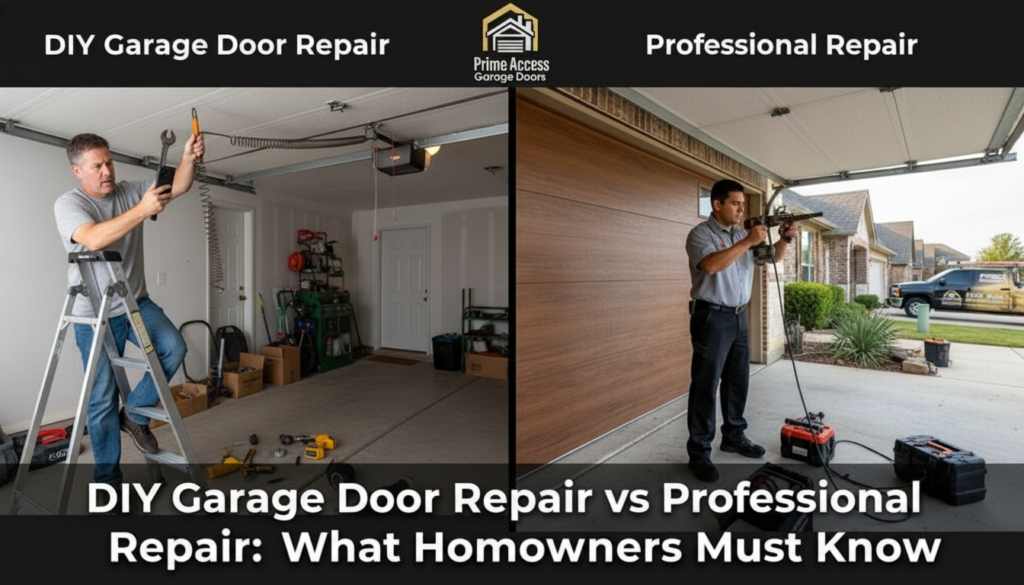
What Is DIY vs Professional Garage Door Repair?
DIY garage door repair involves a homeowner attempting to troubleshoot or fix mechanical issues using standard household tools and online tutorials. This approach is typically limited to basic tasks like weather seal installation or simple, safe garage door maintenance routines that do not involve high-pressure components. In contrast, professional repair is performed by certified technicians who utilize specialized equipment like winding bars to manage extreme spring tension.
Experts bring a level of professional technician certification that guarantees the work meets industry safety standards and local building codes. While DIY focuses on immediate, low-cost fixes, professional service ensures the entire system’s mechanical integrity is restored through expert diagnostic tools. Choosing the professional route provides a comprehensive residential garage door service experience that covers everything from motor calibration to structural alignment.
Why Garage Door Repair Is an Important Decision
Deciding how to handle your garage door issues is a matter of balancing immediate savings against long-term operational safety. A poorly executed repair can lead to broken garage door cable symptoms that compromise the entire lifting mechanism. Since the garage door is the largest moving object in your home, its failure poses a direct threat to your vehicles and family members. You must weigh the garage door repair cost vs DIY risks, considering that mistakes often lead to more expensive professional interventions later. Taking the wrong path can void your manufacturer’s warranty, leaving you financially responsible for full system replacements.
Professional Garage Door Opener Troubleshooting
Modern openers contain intricate circuit boards and sensor arrays that require precise electronic calibration. A professional identifies whether the motor, drive chain, or logic board is failing without the “trial and error” that defines DIY attempts. This targeted approach ensures your garage door opener troubleshooting is handled efficiently, preventing further electrical damage. Experts also verify that the safety reversal system is fully operational to prevent accidental crushing.
Expert Torsion Spring Replacement
Torsion spring replacement is arguably the most dangerous task in residential maintenance due to the immense energy stored in the coils. Professionals use specific safety protocols and high-grade steel components that are not available at local hardware stores. They ensure the garage door spring tension adjustment is perfectly balanced to match the specific weight of your door. Handling this alone without expert tools is a high-risk gamble that rarely ends well for the amateur.
Precision Garage Door Track Alignment
A door that is slightly out of sync will eventually grind the rollers and strain the motor until the system seizes. Garage door track alignment requires laser-level precision to ensure smooth vertical and horizontal travel during every cycle. Technicians check for bracket and hinge reinforcement needs during this process to prevent the door from falling off its rails. Proper alignment extends the lifespan of all moving parts, saving you significant money on premature replacements.
Why Professional Garage Door Repairs Make a Difference
The primary advantage of professional intervention is the assurance of a durable, high-performance outcome that DIY simply cannot replicate. Certified experts provide an emergency garage door repair response that addresses critical failures before they leave your home vulnerable to intruders. Their access to industrial-grade parts means your bracket and hinge reinforcement will withstand years of heavy daily use. Furthermore, a professional technician can spot early broken garage door cable symptoms that a homeowner would likely overlook until the system fails. This proactive level of residential garage door service transforms a simple fix into a long-term investment in your property’s value. Ultimately, the peace of mind knowing your door has been calibrated by an expert far outweighs the minor upfront savings of a DIY attempt.
Cost Considerations Between DIY and Professional Services
Financial planning for home maintenance requires a cold look at the garage door repair cost vs DIY risks. While a homeowner might save on immediate labor fees, the hidden expenses of specialized tools like winding bars and high-grade replacement parts often close the price gap. Professional services eliminate the “trial and error” phase, which frequently leads to secondary damage and inflated repair bills. Furthermore, a certified repair protects your manufacturer’s warranty, a financial safety net that DIY attempts almost certainly destroy. Ultimately, paying for professional expertise is an investment in system longevity that prevents the massive expense of a premature full-system replacement.
Why Most Homeowners Prefer Professional Garage Door Repair Over DIY Fixes
Modern homeowners prioritize safety and operational reliability, leading the vast majority to choose a professional technician certification over amateur fixes. The extreme tension found in overhead systems makes emergency garage door repair a high-stakes task that requires industrial-grade safety protocols. Professionals provide a comprehensive residential garage door service that includes a full diagnostic of the motor, tracks, and counterbalance system. This systematic approach identifies early broken garage door cable symptoms before they escalate into a dangerous mechanical collapse. By delegating these tasks, residents ensure their property remains secure without risking personal injury or long-term structural instability.
Advanced Technical Troubleshooting
Certified experts utilize diagnostic equipment to pinpoint the root cause of electrical or mechanical failure within seconds. During garage door opener troubleshooting, they analyze circuit board integrity and sensor alignment to ensure the safety reversal system is flawless. This level of precision prevents the common DIY mistake of replacing expensive parts that aren’t actually broken. A professional ensures that every adjustment contributes to the overall efficiency of the automated system.
Management of High-Tension Hardware
Handling torsion spring replacement requires a specific understanding of torque and mechanical force that is beyond the average toolkit. Technicians use professional-grade winding bars to safely manage the thousands of pounds of pressure stored in these components. A single mistake during garage door spring tension adjustment can lead to catastrophic hardware failure or severe physical trauma. Homeowners prefer the accountability and specialized safety gear that only a professional service can provide.
Long-Term Parts and Labor Warranties
A primary driver for professional selection is the legal and financial protection offered through service guarantees. Most high-quality repair companies provide extended warranties on bracket and hinge reinforcement and other critical hardware. This means if a component fails prematurely, the homeowner is not liable for the cost of a follow-up visit. DIY repairs offer no such protection, leaving the property owner vulnerable to recurring costs if the initial fix fails.
Key Differences Between DIY and Professional Repairs
The fundamental difference lies in the level of mechanical precision and the quality of the components utilized during the service. Professional garage door track alignment is performed with laser-level accuracy to prevent the motor from straining against friction, whereas DIY attempts often rely on visual estimation. Technicians ensure safe garage door maintenance by adhering to a 20-point inspection checklist that covers everything from weather seal installation to lubrication. While a DIY fix is often a reactive “band-aid” solution, a professional repair is a proactive restoration of the door’s original engineering specifications. The following table provides a detailed breakdown of these critical distinctions:
DIY vs. Professional Repair Comparison Matrix
| Feature | DIY Approach | Professional Service | Long-Term Impact |
| Safety Risk | High risk of spring/cable snap | Low; OSHA-compliant protocols | Risk of injury vs. peace of mind |
| Tooling | Standard household tools | Winding bars & laser levels | Precision vs. “make-shift” fixes |
| Component Quality | Retail-grade (short lifespan) | Industrial-grade hardware | Frequency of future failures |
| Warranty Status | Usually voids the manufacturer’s terms | Maintains & provides new warranty | Financial liability vs. protection |
| Troubleshooting | Visual/Guesswork | Technical opener troubleshooting | Root cause fix vs. symptom fix |
| Alignment | Manual estimation | Precision track alignment | Motor strain vs. smooth operation |
| Seal Integrity | Basic weather seal installation | Structural-grade sealing | Energy loss vs. insulation |
| Emergency Support | None (limited to own time) | 24/7 emergency repair access | Security downtime vs. instant fix |
Pros and Cons of DIY vs Professional Garage Door Repair
Selecting between a self-performed fix and a certified technician requires a strategic evaluation of the “Pros and Cons” regarding safety, durability, and cost. While a DIY approach offers the immediate gratification of a lower upfront bill, it often lacks the structural precision found in a high-quality residential garage door service. Conversely, professional intervention ensures that critical systems like garage door track alignment and motor calibration meet exact engineering specifications. Ignoring the technical complexities of Garage Door Repair can lead to recurring mechanical failures that eventually exceed the cost of an initial professional visit. Ultimately, the decision hinges on whether you value a temporary “quick fix” or a long-term investment in your property’s operational security.
DIY Repair: The Benefits and Drawbacks
- Immediate Labor Savings: You avoid paying the service call fees and hourly labor rates typically associated with a professional technician certification.
- Flexible Scheduling: You can perform minor tasks like weather seal installation or lubrication at your own convenience without waiting for a technician’s arrival.
- Inadequate Tooling: Most homeowners lack specialized hardware like winding bars, leading to “make-shift” repairs that can compromise the door’s mechanical integrity.
- High Physical Risk: Attempting a torsion spring replacement without expert training poses a severe threat of blunt-force trauma or structural collapse.
Professional Repair: The Benefits and Drawbacks
- Guaranteed Safety Protocols: Certified experts handle high-tension components using OSHA-compliant methods, ensuring safe garage door maintenance for your entire household.
- Comprehensive Warranty Coverage: Professional work typically includes a guarantee on both parts and labor, protecting you from the financial burden of future emergency garage door repair needs.
- Higher Initial Investment: The upfront garage door repair cost vs DIY is notably higher due to the use of industrial-grade parts and specialized labor.
- Diagnostic Precision: Technicians provide accurate garage door opener troubleshooting to find root causes, preventing you from wasting money on unnecessary part replacements.
Conclusion
Choosing between professional intervention and a self-repair attempt is ultimately a decision regarding the long-term mechanical integrity of your home’s most substantial moving part. While the immediate savings of a DIY approach are often publicized, they rarely account for the high-stakes risks associated with torsion spring replacement or the precision required for garage door track alignment. A certified technician provides the diagnostic accuracy and industrial-grade hardware, such as bracket and hinge reinforcement, that ensures the system operates far beyond a temporary fix. Investing in professional expertise eliminates the mechanical blind spots that lead to catastrophic failures and preserves the overall value of your residential property.
Prioritizing a professional technician certification over unverified tutorials is the only guaranteed method to maintain a rigorous standard of safe garage door maintenance. Experts not only resolve immediate issues like broken garage door cable symptoms but also offer the legal protection of labor warranties and manufacturer compliance. This proactive strategy prevents the cycle of recurring malfunctions and secures your home against the vulnerabilities of a compromised entry point. By choosing a comprehensive residential garage door service, you trade the “trial and error” of amateur repairs for a high-performance system that delivers lasting safety and operational reliability.
Frequently Asked Questions (FAQs)
How does garage door weight affect the selection of professional hardware? Professional technicians calculate the exact foot-pounds of torque required to ensure the lifting mechanism perfectly counterbalances the specific door weight. Using generic retail parts often leads to premature motor burnout because the tension is not precisely calibrated to the door’s mass.
Can DIY repairs negatively impact my home’s resale value? Uncertified repairs often result in visible mechanical inconsistencies and noise issues that alert home inspectors to potential safety liabilities. Professional service documentation acts as a technical asset, proving to future buyers that the home’s largest moving structure is maintained to industry standards.
What are the environmental benefits of professional weather seal installation? Expertly fitted seals create a structural barrier that significantly reduces thermal exchange, lowering your household energy consumption throughout the year. Improperly aligned DIY seals frequently leave microscopic gaps that invite pest infestations and compromise your garage’s climate control.
Why is professional lubrication superior to standard household oiling? Technicians utilize high-performance, non-silicone-based lubricants designed to withstand extreme temperature fluctuations without attracting abrasive debris. Household oils often gum up the tracks over time, creating a sticky residue that accelerates the wear and tear on your rollers.
Does temperature affect the urgency of garage door repairs? Extreme cold can cause metal components to contract and become brittle, making existing hairline fractures in springs or tracks highly susceptible to sudden snapping. Professional winterization services ensure that your hardware remains resilient against the physical stresses induced by freezing conditions.
How do professional technicians verify the safety reversal system? Experts use standardized block tests and force-setting diagnostics to ensure the door detects an obstruction and reverses instantly according to federal safety laws. Homeowners often lack the testing equipment to confirm if their sensors are communicating correctly with the motor’s logic board.
Is it possible to upgrade my garage door’s security during a routine repair? Certified technicians can integrate modern rolling-code technology and tamper-resistant brackets that prevent intruders from manually bypassing your opener. These security enhancements are technical upgrades that go far beyond the scope of basic mechanical part replacement.
How often should a professional 20-point inspection be conducted? An annual professional evaluation is recommended to identify hidden structural fatigue in the counterbalance system and internal motor gears. This proactive frequency prevents minor alignment issues from escalating into expensive, full-scale mechanical failures during peak usage seasons.
