
Neglecting a professional garage door evaluation is the fastest way to turn a minor mechanical hiccup into a total system collapse. A high-functioning door relies on a delicate balance of tension and alignment, where even slight vibration and noise patterns signal impending failure. Most homeowners ignore these early warnings, unaware that heat-related fatigue is silently compromising the structural integrity of their hardware. Real expertise starts with a comprehensive garage door check that identifies pre-existing conditions before they escalate into dangerous, high-cost emergency repairs.
A systematic garage door maintenance routine is the only defense against the root causes of mechanical resistance that plague heavy moving parts. When you ignore the real-world behavior of your system, you aren’t just risking convenience; you are jeopardizing your home warranty considerations and family safety. Precision diagnostics allow you to calibrate force settings and travel limits, ensuring the motor doesn’t burn out prematurely. Understanding the interplay between counterbalance door weight and opener efficiency is the difference between a door that lasts twenty years and one that fails in five.
What are the functions of maintenance and repair diagnostics?
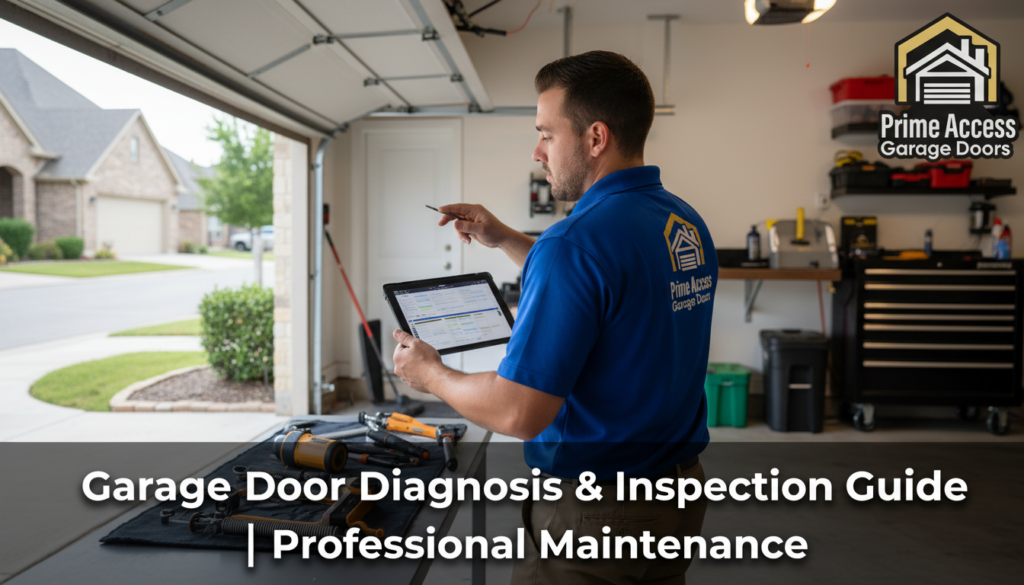
Diagnostics serve as the technical roadmap to ensure garage door opener performance remains within factory specifications while protecting the user. By evaluating the garage door safety systems, a technician can confirm that the auto-reverse and photo-eye sensors are responding to obstructions instantly. This process uncovers hidden friction within the tracks and rollers that causes unnecessary strain on the motor and drive assembly. Ultimately, these diagnostics validate the structural integrity of the entire unit, ensuring every component handles the daily stress of operation without catastrophic snapping.
Strange Noises During Operation
Unexpected sounds are never “normal” wear and tear; they are audible evidence of vibration and noise patterns caused by loose hardware or lack of lubrication. If your door is shrieking or grinding, the root causes of mechanical resistance are likely found in worn bearings or unaligned tracks. Ignoring these sounds leads to heat-related fatigue in the motor as it struggles to overcome the friction of a poorly maintained system.
Analyzing Metal-on-Metal Friction
Grinding noises usually indicate that the rollers are no longer spinning freely within the tracks. This creates localized heat that warps the metal over time, leading to permanent alignment issues. Consistent lubrication is the only way to prevent this specific type of structural degradation.
Identifying Worn Torsion Springs
A loud “bang” or persistent squeaking from the header area suggests the counterbalance door weight is no longer supported. Springs have a limited cycle life, and once they lose tension, the opener must lift the full weight of the door. This imbalance creates a dangerous environment where the door could drop without warning.
Slow, Jerky, or Hesitant Movement
When a door moves with hesitation, the garage door opener’s performance is being throttled by a physical obstruction or an electrical limit. This “jerky” movement is often a symptom of failing weather seals that have become brittle and are catching in the side tracks. If the movement isn’t fluid, the system is likely fighting against pre-existing conditions like rusted hinges or bent track brackets.
Assessing Force Setting Calibration
Modern openers have internal force settings designed to stop the motor if too much resistance is detected. If these settings are too sensitive, the door will hesitate or reverse for no apparent reason. Adjusting these requires a professional to ensure safety isn’t compromised for the sake of speed.
Won’t Open or Close Completely
A door that fails to reach its destination is usually struggling with incorrect travel limits or blocked garage door safety systems. If the door hits the floor and immediately reverses, the downward force is likely set too high, or the floor has shifted over time. These issues are common real-world behavior patterns that indicate the electronic “brain” of the opener is out of sync with the physical position of the door.
Inspecting Safety Sensor Alignment
The garage door safety systems are the most frequent cause of a door refusing to close at all. If the photo-eyes are misaligned or blocked by debris, the system assumes an object is in the path. Cleaning the lenses and ensuring the brackets are tight is the first step in any diagnostic check.
Evaluating Track Obstructions
Dirt, grease buildup, or small stones can prevent the rollers from reaching the end of the travel limits. Even a small pebble in the track can trigger a safety reversal, making the door appear broken when it simply needs a cleaning. Checking the track’s end-points ensures the weather seals can make a tight, energy-efficient seal with the ground.
Door Appears Crooked or Unbalanced
A crooked door is a visual warning that the counterbalance door weight is no longer distributed evenly across the lifting system. This usually happens when one torsion spring has lost more tension than the other or a cable has slipped off its drum. Operating a door in this state is a gamble; the uneven load puts immense pressure on the rollers and tracks, leading to rapid structural integrity failure. Without a professional garage door evaluation, the opener will eventually burn out as it tries to compensate for the dead weight of an unbalanced slab.
Visible Cable or Spring Damage
Frayed cables or gaps in your springs are “red alert” pre-existing conditions that demand an immediate garage door check. Springs are under high tension and suffer from heat-related fatigue over years of seasonal temperature shifts, making them prone to snapping. If you see “cleaning” or thinning on the cables, they are likely rubbing against the track, which creates root causes of mechanical resistance. Never attempt to adjust these yourself; the stored energy in a counterbalance system is enough to cause severe injury or property damage.
Remote Control or Wall Switch Issues
When your door fails to respond to commands, the issue often lies in the communication between the hardware and the garage door opener’s performance settings. Frequency interference or depleted batteries are the simple fixes, but persistent lag suggests a failing logic board or damaged wiring. If the wall switch works but the remote doesn’t, you may be dealing with a signal range issue caused by modern LED bulbs or nearby radio towers. Checking these connections is a vital part of garage door maintenance to ensure you aren’t locked out during an emergency.
Diagnosing Signal Interference
Electronic “noise” from household appliances can often disrupt the signal sent from your remote to the opener. Technicians look for shielding issues or outdated receivers that can no longer filter out local radio traffic. Upgrading to a dual-frequency remote often solves this “ghost” behavior without replacing the entire motor.
Assessing Logic Board Health
The logic board acts as the brain of your system, controlling everything from travel limits to light timers. If the board is failing due to a power surge, you may notice the door moving on its own or the lights flashing randomly. Replacing the board is a cost-effective alternative to a full opener replacement if the mechanical parts are still sound.
Wiring and Connection Integrity
Corroded wires between the wall button and the motor unit can lead to intermittent operation. Professional diagnostics involve testing the continuity of these wires to ensure a steady 24V signal is reaching the opener. This is especially important in humid climates where copper wiring can oxidize and lose conductivity.
Higher Energy Bills
An unexpected spike in your utility costs is often tied to the failure of your weather seals and the bottom rubber gasket. If your garage is attached to your home, a poorly sealed door acts like a giant hole in your thermal envelope, allowing conditioned air to escape. This is a classic example of how minor garage door maintenance affects your entire home’s efficiency. Replacing brittle seals prevents drafts and keeps your HVAC system from working overtime to compensate for the temperature leak.
Insulated Section Alignment
If your door panels are insulated but no longer sit flush against each other, the R-value of the door is compromised. This “thermal bridging” occurs when the hinges are loose or the structural integrity of the panels has been damaged. Re-aligning the sections ensures the insulation performs as intended by the manufacturer.
Bottom Gasket Compression
The bottom seal must be thick enough to compensate for an uneven garage floor to prevent air and water entry. Over time, the weight of the door flattens this rubber, leaving gaps at the corners where pests and cold air enter. A high-quality U-shaped gasket is the best defense against these environmental efficiency losses.
Door Reverses Randomly
When a door reverses without a visible obstruction, it is usually a conflict between the force settings and the garage door safety systems. The opener’s internal sensors may be detecting “phantom” resistance caused by a lack of lubrication or a bent track. This real-world behavior is the system’s way of preventing the motor from stripping its internal gears. A professional must recalibrate the sensitivity to ensure the door closes securely without bypassing the critical safety reverse feature.
Calibrating Sensitivity Logic
The force adjustment dials on the back of the opener control how much pressure the motor applies before it gives up. If set too low, the door will reverse at the slightest breeze; if too high, it becomes a safety hazard. Balancing these settings requires precise testing with a standard 2×4 block to meet UL325 safety standards.
Excessive Shaking or Vibration
A door that shakes violently is suffering from high-frequency vibration and noise patterns that will eventually rattle the mounting hardware loose. This is often caused by “out-of-round” rollers or a motor that has been secured to a weak ceiling joist. This shaking isn’t just annoying; it causes metal fatigue in the hinges and can lead to the door falling off its tracks. Consistent vibration is a primary symptom of poor structural integrity in the support system.
Inspecting Roller and Bearing Wear
Rollers with worn-out ball bearings will wobble inside the track rather than rolling smoothly. This side-to-side movement sends vibrations through the entire door panel, loosening the screws that hold the hinges in place. Upgrading to nylon rollers with sealed bearings provides a much quieter and more stable operation.
Motor Mount Stabilization
If the opener unit itself is shaking, the vibration can crack the internal plastic gears or loosen the chain tension. Professionals use perforated angle iron to create a “triangulated” brace that anchors the motor firmly to the garage structure. This eliminates the swaying motion that contributes to premature motor failure.
Professional Diagnosis and Repair
Attempting a DIY fix on a complex mechanical system is how minor issues become expensive disasters that void your home warranty considerations. A professional garage door evaluation provides a comprehensive look at the real-world behavior of your door under stress. Experts can identify pre-existing conditions that the untrained eye would miss, such as hairline cracks in the opener bracket or microscopic fraying on the cables. Investing in a certified technician ensures that your garage door safety systems in TX are fully functional and that your home remains secure.
Conclusion
A high-performance garage door system demands more than reactive repairs; it requires a proactive commitment to technical precision and structural care. By addressing heat-related fatigue and vibration and noise patterns early, you prevent the compounding failures that lead to total mechanical collapse. Prioritizing a professional garage door evaluation ensures that every component—from weather seals to counterbalance door weight—operates within its intended safety parameters.
Ultimately, the real-world behavior of your door serves as a direct reflection of your maintenance standards and home warranty considerations. Ignoring the root causes of mechanical resistance doesn’t just invite inconvenience; it compromises the structural integrity and safety of your entire residence. Secure your investment by validating your force settings and garage door safety systems, ensuring your hardware remains a reliable asset rather than a hidden liability.
FAQS
How much is a garage door inspection?
A standard professional garage door keller evaluation typically costs between $75 and $150, depending on your local market and the complexity of the system. This fee generally covers a comprehensive garage door check of all safety sensors, hardware tension, and motor calibration to ensure peak opener performance.
What are some common garage door problems and fixes?
Common issues often stem from heat-related fatigue in the springs or worn-out weather seals that cause drafts and operational resistance. Most fixes involve lubricating moving parts to eliminate vibration and noise patterns or recalibrating travel limits to ensure the door closes flush against the floor.
What is the most common garage door repair?
The most frequent repair involves replacing snapped or weakened torsion springs that can no longer support the counterbalance door weight. Because these components are under extreme tension and affect the structural integrity of the entire system, this fix is critical for maintaining long-term garage door safety systems.
How do I do an inspection on my garage door?
You can perform a basic inspection by observing the real-world behavior of the door for any jerky movements and listening for the root causes of mechanical resistance like grinding or squeaking. Additionally, test the force settings by placing an object in the door’s path to confirm the auto-reverse safety feature triggers instantly.
How often should a garage door be inspected?
For optimal performance, a professional garage door maintenance check should be scheduled at least once a year to identify pre-existing conditions. Frequent inspections are especially vital in regions with extreme temperature swings to prevent heat-related fatigue from compromising your home warranty considerations.
