
The structural integrity of a Garage Door Track is the primary determinant of an overhead system’s lifespan and operational safety. In high-cycle environments, even a 2-millimeter deviation in Door Alignment can trigger a catastrophic failure, as the kinetic energy of the door is no longer distributed evenly across the Vertical Tracks. Research into residential structural failures confirms that a compromised Garage Door Track creates a “domino effect,” where the lack of precise Track Spacing forces the Torsion System to work against localized friction, ultimately leading to snapped cables or motor burnout.
When a Garage Door Track loses its plumb orientation, the system’s Force Margin is exceeded, causing the rollers to exert lateral pressure against the steel rails. This friction accelerates Metal Fatigue, turning a simple maintenance task into a high-stakes emergency where the door may become unseated from its mounting brackets. Restoration of the track’s geometry is not merely a cosmetic fix; it is a critical recalibration of the door’s center of gravity to prevent the door from falling under the immense Torsion Tension that holds the entire assembly in place.
Understanding Garage Door Track Problems
The functionality of your entry system relies entirely on the mathematical precision of Door Alignment relative to the mounting brackets. When a track becomes warped or shifted, it creates a bottleneck that triggers Roller Binding, forcing the motor to pull against dead weight. This friction doesn’t just slow the door down; it accelerates Metal Fatigue across the hinges and fasteners, leading to a jagged, unstable movement. Without a perfectly calibrated Force Margin, the door’s safety sensors may fail to compensate for the drag, resulting in a door that reverses unexpectedly or jams halfway.
Mechanical Track Displacement
When the fasteners securing the steel rails to the wall framing loosen, the resulting Track misalignment creates a lethal gap in the door’s travel path. This displacement forces the rollers to jump the track, often leaving the heavy door hanging by a single point of contact. Professionals must reset the track using laser levels to ensure the vertical and horizontal planes are perfectly synchronized.
Roller and Rail Friction
Friction is the silent killer of overhead systems, often caused by a buildup of Rust Scale within the track’s inner channel. This oxidation creates a sandpaper effect that grinds down the nylon or steel rollers, eventually causing them to seize entirely during a cycle. Systematic cleaning and the application of high-grade lithium grease are required to prevent this friction from snapping the Garage door cables.
Structural Integrity Loss
Over time, the constant vibration of a 200-pound door causes the steel to succumb to stress fractures and structural bowing. If the Vertical Tracks are not made of a sufficient gauge of steel, they will eventually buckle under the operational load of the Torsion system. Regular inspections are the only way to catch these microscopic bends before they lead to a total “off-track” event.
Common Causes of Garage Door Track Damage
Track damage is rarely an isolated incident; it is usually the result of external impact or a failure in the supporting hardware. Most homeowners deal with Bent garage door tracks after a vehicle “love tap” or because the door closed on an obstruction that the sensors failed to detect. This sudden impact creates a kink in the steel that prevents the rollers from passing through, putting immense strain on the Garage door rollers and the drive rail. Beyond physical impact, the natural shifting of a home’s foundation can slowly pull the tracks out of their original, factory-set alignment.
Vehicle and Object Impact
The most common cause of a bent rail is a direct hit from a car or a heavy trash bin placed too close to the opening. Even a low-speed impact can distort the thin-gauge steel, making it impossible for the door to complete a full cycle without jamming. Attempting to hammer these bends back into place often weakens the metal further, necessitating a full track replacement.
Broken Support Cables
When Garage door cables snap or slip off their drums, the weight of the door shifts entirely to one side, twisting the tracks instantly. This uneven distribution of weight exerts a sideways force that the tracks were never designed to withstand, leading to immediate bowing. This is a high-risk scenario where the Torsion Tension is no longer controlled, making professional repair a requirement.
Obstruction and Force Settings
If the opener’s force settings are turned too high, the motor will continue to push the door down even if it hits an object on the floor. This downward pressure forces the rollers outward against the track walls, causing them to “mushroom” or flare out. This damage destroys the Track Spacing and requires specialized tools to re-crimp or replace the damaged sections.
Our Garage Door Track Repair Services
Our technical team specializes in the precision restoration of high-tension overhead systems, focusing on the immediate correction of Vertical Tracks and structural misalignments. We don’t just patch the symptoms; we analyze the entire geometry of your door to ensure that Track Spacing meets the exact manufacturer specifications for your specific model. Utilizing industrial-grade straightening tools and laser-alignment technology, we eliminate Roller Binding and restore the smooth, silent travel your system was designed for.
Every service call includes a comprehensive safety audit of the Torsion System to ensure that your tracks aren’t being subjected to uneven mechanical loads. We offer Same-day garage door repair because a door out of alignment is a high-risk liability that cannot wait for a scheduled appointment.
Professional Track Realignment
We utilize heavy-duty clamping systems to reset warped rails back to their original factory plumb without compromising the molecular integrity of the steel. This process involves recalibrating the wall brackets and ensuring that the Door Alignment is consistent from the floor to the radius. Proper alignment prevents the rollers from rubbing against the track edges, which is the leading cause of premature wear.
Industrial-Grade Hardware Upgrades
For systems suffering from significant wear, we replace standard-duty components with high-gauge steel tracks and reinforced mounting hardware. This upgrade significantly improves the Force Margin of your door, allowing it to withstand higher wind loads and frequent operational cycles. We also inspect and replace damaged Garage door rollers with sealed-bearing nylon alternatives for superior longevity.
Emergency Stabilization and Safety
When a door is hanging precariously off its rails, our first priority is the mechanical stabilization of the entire unit to prevent a free-fall. We safely manage the Torsion Tension while reseating the door, ensuring that no further damage occurs to the panels or the opener’s drive rail. This service is critical for preventing secondary failures in the Garage door cables during the repair process.
Garage door off-track repair cost
The financial investment for repairing a door that has jumped its rails varies based on the severity of the hardware damage and the state of the Torsion system. A standard realignment and roller reset typically falls into a mid-range service fee, whereas a full cable and track overhaul requires more labor and specialized components. You must factor in the cost of replacing Garage door cables if they have frayed during the incident, as reusing damaged cables is a major safety violation.
High-cycle springs and heavy-duty steel tracks will also influence the final invoice, but these upgrades prevent recurring costs associated with frequent breakdowns. Ultimately, seeking Same-day garage door repair is more cost-effective than waiting, as a jammed door can eventually burn out your opener’s motor, doubling the repair bill.
Labor and Diagnostic Fees
Professional technicians charge based on the complexity of the stabilization required to safely handle a door under high Torsion Tension. Diagnostic fees often cover a full system inspection to identify if a broken spring or worn pulley was the original cause. This upfront cost ensures the underlying mechanical failure is resolved, preventing a repeat of the track displacement.
Hardware and Component Replacement
The cost of physical parts, such as new Vertical Tracks or reinforced brackets, depends on the gauge of the steel and the height of the door. Specialized hardware designed for high-moisture environments or heavy-duty industrial use will carry a premium but offers a longer lifespan. Replacing these components during an off-track event is often more affordable than scheduling a separate installation later.
Emergency and After-Hours Premiums
Requesting immediate intervention for a door that is stuck open or hanging dangerously often incurs an emergency service fee. However, this cost is a necessary trade-off for securing your home’s main entrance and preventing the potential for physical injury or theft. In most cases, Same-day garage door repair prevents the damage from spreading to the opener or the door panels.
Why a Garage Door May Come Off Track or Appear Crooked
A crooked door is almost always a symptom of an imbalance within the Torsion system or a failure in the lifting cables. If one cable stretches or slips off its drum, the door will pull unevenly, forcing the rollers on one side to jam against the Vertical Tracks. This creates a diagonal orientation that quickly exceeds the track’s width, causing the rollers to pop out of the channel entirely. Over time, even minor Track misalignment can cause the door to appear lopsided as it struggles to overcome the friction of a warped rail. Identifying the root cause—whether it is a broken spring or a loose mounting bolt—is essential before attempting to level the door.
Cable Tension Imbalance
When the tension on the lifting cables becomes unequal, the door is pulled up at an angle rather than a perfectly horizontal line. This imbalance puts massive lateral pressure on the Garage door tracks, eventually forcing the rollers out of their designated path. Without a balanced pull, the door’s weight shifts entirely to one side, risking a total track collapse.
Obstruction and Sensor Failure
If the door closes on an object, like a trash can or a broom handle, the side that hits the object stops while the other side continues to move. This “scissor effect” bends the Garage door rollers and can easily twist the track out of its wall mounts. Modern safety sensors should prevent this, but mechanical lag can still cause a significant Bent garage door tracks scenario.
Worn or Seized Rollers
A roller that no longer spins acts as a brake, dragging along the track and pulling that side of the door down. This dragging leads to Roller Binding, which eventually yanks the track out of alignment and leaves the door looking crooked during operation. Regular replacement of high-friction rollers is the best way to maintain the integrity of the Vertical Tracks.
Step-by-Step Guide to Fixing a Garage Door That’s Off Track
Restoring a door to its rails is a high-precision task that requires deactivating the power and securing the door’s weight with locking pliers. The first step involves opening the track at a strategic point to guide the Garage door rollers back into the channel without further damaging the steel. Once the rollers are reseated, the Track Spacing must be checked and the mounting bolts tightened to prevent the rail from shifting again.
It is vital to check the Garage door cables for any signs of fraying or displacement from the drums before attempting to cycle the door. Finally, the Force Margin on the opener must be tested to ensure the motor isn’t overcompensating for any remaining friction in the system.
Secure and Disconnect
Before touching the tracks, you must pull the emergency release cord to disconnect the door from the opener and lock the door in place using C-clamps. This prevents the door from crashing down while you are working near the Vertical Tracks and the spring assembly. Never attempt to adjust a door that is still connected to the power source.
Reseat the Rollers
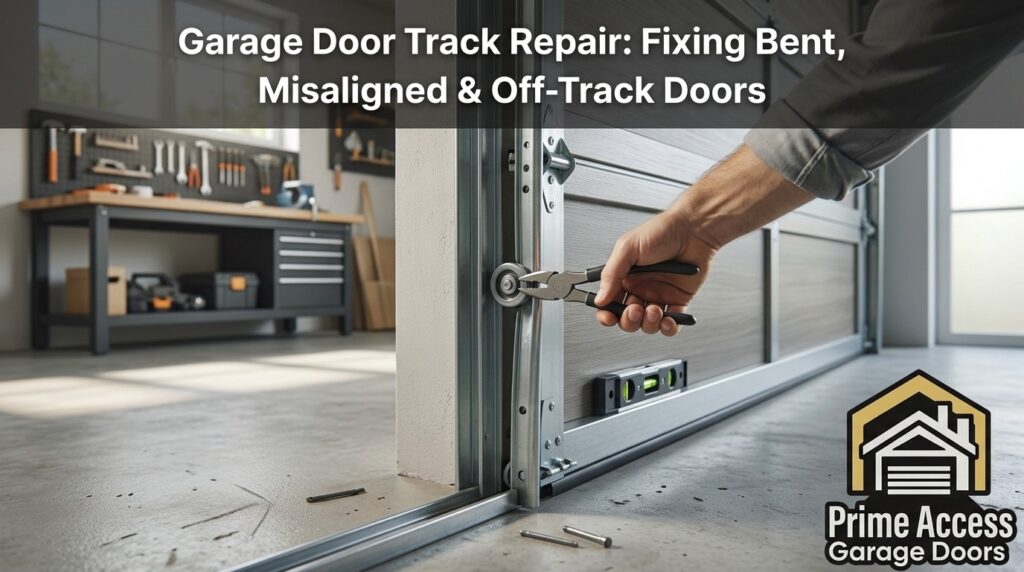
Using a pair of pliers, you may need to slightly move the edge of the track to allow the rollers to slide back in. This must be done gently to avoid creating Metal Fatigue or permanent kinks in the Garage door tracks that would hinder future movement. Once reseated, the track edge must be hammered back into its original profile to ensure a smooth path.
Test and Calibrate
Once the door is back on its path, manually move it up and down to check for any points of resistance or Roller Binding. If the door moves smoothly, reconnect the opener and run a full cycle to ensure the Door Alignment is perfect and the safety sensors are clear. Always observe the first few cycles from a safe distance to confirm the Torsion system is balanced.
Conclusion
The technical integrity of your overhead system is a non-negotiable factor in residential safety and operational efficiency. Addressing issues like Track misalignment and Roller Binding through professional recalibration ensures that the Torsion System remains balanced and within safe operational limits. By prioritizing high-gauge Vertical Tracks and exact Track Spacing, you effectively mitigate the risk of catastrophic hardware failure and extend the service life of your entire garage door assembly.
A proactive approach to maintenance, focusing on the elimination of Rust Scale and the management of Metal Fatigue, is the most cost-effective strategy for long-term home security. Utilizing Same-day garage door repair for immediate needs such as Bent garage door tracks or frayed Garage door cables prevents the compounding damage that leads to motor burnout or structural collapse. Ultimately, maintaining a precise Door Alignment and a healthy Force Margin guarantees that your entry system operates as a seamless, high-performance asset rather than a mechanical liability.
FAQS
How can I tell if my track issues are caused by foundation shifting?
Foundation settlement often manifests as Track misalignment that appears gradually, causing the door to rub against the frame only during specific seasons. If you notice the Vertical Tracks are leaning or if the gap between the door and the jamb is wider at the top than the bottom, your home’s structure may be pulling the mounting brackets out of plumb. A professional must use slotted brackets to compensate for this shift and restore a perfect Door Alignment.
Can I lubricate a track to fix a noisy, bent rail?
Applying grease to a bent Garage door track is a common mistake that actually accelerates Roller Binding by attracting debris into the kinked area. Lubrication is designed for moving parts like Garage door rollers, not the stationary track surface where it can cause the rollers to slide instead of spin. If the rail is bent, the only solution is mechanical straightening or replacement to ensure the Force Margin remains within safe limits.
What is the difference between a “Standard” and a “Low-Headroom” track?
Standard tracks require approximately 12 inches of overhead space, while low-headroom systems utilize a dual-track design to navigate tight structural constraints. If your Torsion system is mounted in a restricted space, using the wrong track geometry will lead to immediate Metal Fatigue and cable throwing. Choosing the correct track profile is essential for maintaining the proper Track Spacing required for the door to clear the header safely.
Does the gauge of the steel track really matter for residential doors?
The thickness of the steel, measured in gauge, directly impacts the track’s resistance to bowing and Metal Fatigue over thousands of cycles. Most builder-grade systems use thin 18-gauge steel, but upgrading to 14-gauge Vertical Tracks provides a much higher Force Margin and prevents bending from minor impacts. Heavier-gauge steel is a critical investment for wide double-car doors or insulated models that exert higher lateral pressure.
What happens if I ignore “Rust Scale” on my vertical tracks?
Surface oxidation eventually leads to “pitting,” which creates a jagged internal surface that shreds the outer layer of your Garage door rollers. This increased friction forces the Torsion Tension to pull harder to overcome the drag, which can snap your Garage door cables without warning. In coastal or high-humidity environments, stainless steel or powder-coated tracks are the only way to prevent this chemical degradation from compromising the system.
